Note: This article refers to Claude Code (Anthropic’s AI coding agent), not a product named “Open Claude.” The story is about proprietary source that became public by mistake.
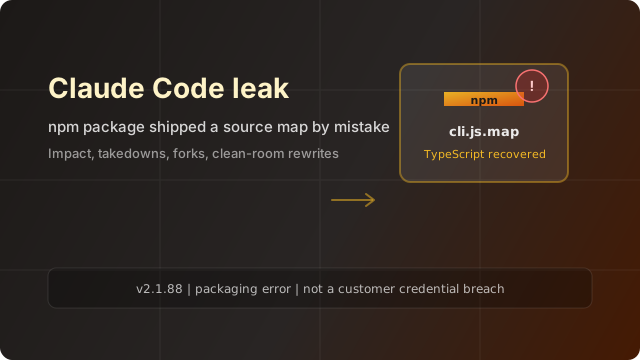
On March 31, 2026, Anthropic published @anthropic-ai/claude-code version 2.1.88 to npm. The package included a JavaScript source map (cli.js.map, on the order of tens of megabytes). Source maps are meant for debugging: they can embed sourcesContent, which reconstructs original sources from the bundled output.
Because build artifacts were not excluded from the published package (widely reported as a missing .npmignore or package.json files configuration), anyone who pulled that npm version could recover what reporting describes as on the order of ~512,000 lines of TypeScript across ~1,900 files. This was not a network breach of Anthropic’s internal systems—it was normal package installation surfacing data that was never supposed to ship.
Security researcher Chaofan Shou was among the first to publicize the finding; discussion spread quickly on X and Hacker News. Outlets including Decrypt covered the story.
Anthropic’s statement to Decrypt framed it as a packaging error, not a security incident involving customer data:
“Earlier today, a Claude Code release included some internal source code. No sensitive customer data or credentials were involved or exposed. This was a release packaging issue caused by human error, not a security breach. We're rolling out measures to prevent this from happening again.”
So the “leak” is more accurately self-published source that was never intended for distribution—not a hack, but still a severe operational mistake.
What was inside (and why it mattered)
Technical write-ups—such as Layer5’s engineering analysis—summarize the kinds of material that escaped:
- Product and architecture: CLI orchestration, tool and plugin structure, permission and sandboxing logic, terminal UI stack, multi‑agent patterns described in prompts and code.
- Unreleased or gated behavior: Dozens of feature flags and internal codenames mapping to roadmap items competitors would prefer to learn on their own schedule.
- Design choices that sparked debate: Coverage highlighted an “undercover” mode (discussed as reducing attribution or AI disclosure in some flows), which critics framed as a trust issue and defenders as internal hygiene.
Even unremarkable lines of code add up: the combination functions like a compressed product-strategy memo you cannot un-publish.
Impact
Strategic and competitive
You can refactor implementation in weeks; you cannot refactor a leaked roadmap. Competitors and open-source projects gained a detailed picture of how a leading agent CLI is structured—what problems were prioritized, how experiments are gated, and how orchestration is approached. Many observers argue the model and API matter more than the shell, but enterprise buyers still pay partly for perceived exclusivity of the full stack.
Security
Readable source lowers the cost of finding bugs in permission models, bash validation, OAuth handling, and supply-chain touchpoints—for defenders and attackers. The timing also sat in a noisy period for npm trust in some accounts (unrelated malicious packages elsewhere), which reinforces that install paths are fragile.
Trust and brand
Companies that emphasize care and safety take a reputational hit when a headline-scale packaging mistake suggests operational rigor is under strain—especially when customers are choosing who gets agentic access to code and infrastructure.
How Anthropic responded
Public reporting describes several layers:
- Containment at the source: Stop distributing the bad npm artifact so new installs do not keep shipping the map.
- Communication: The quoted statement distinguishes internal source from customer secrets and credentials—important for compliance-minded buyers even though source leakage remains serious.
- Legal tooling: Widespread reports describe DMCA takedowns aimed at GitHub mirrors hosting verbatim recovered TypeScript. Central platforms typically comply; that does not erase copies on personal machines, informal mirrors, or decentralized hosting (Decrypt and others mention harder-to-unpublish mirrors).
- Process fixes: “Rolling out measures to prevent this from happening again” is the predictable closure—release checklists, CI blocking
*.mapin publish artifacts, stricternpm publishallowlists, and executive scrutiny after a hit of this scale.
Claude is the product; handling is Anthropic’s legal, engineering, and communications work—the models did not choose to leak; release configuration did.
What happens to a project that forked it?
The answer depends on what you forked.
Direct fork of the leaked TypeScript
If a repo is essentially hosting or redistributing Anthropic’s copyrighted source recovered from the npm artifact, it falls in straightforward DMCA territory on GitHub and similar U.S.-hosted platforms. Likely outcomes:
- Takedown or a private repo to avoid repeat notices.
- Legal exposure if you commercialize or redistribute, even though you did not “hack” anyone—you are still copying their work without a license.
Forking after someone else uploaded it does not grant you a license.
Clean-room or translated reimplementations
Coverage highlighted projects described as rebuilding architecture in another language (for example Python) from high-level understanding—sometimes with heavy AI assistance—rather than byte-for-byte copying. Commentators such as Gergely Orosz surfaced the tension: if the outcome is a new implementation, is it infringing—or awkward for Anthropic to argue AI-assisted outputs are too close to originals, given industry fights over AI outputs and copyright?
Reality check:
- Untested in court for this exact fact pattern.
- Not risk-free: “Clean room” is a specific legal process; retyping structure with the leaked repo open beside you is not the same as documented separation.
- Practical risk: Enterprises may still avoid stacks whose lineage sits in a famous dispute.
Decentralized or personal copies
DMCA is effective against named hosts, not against every copy. That is why commentary often says the leak is effectively permanent in a social and technical sense—not that copyright vanished.
Lessons
- Treat publish pipelines as security boundaries.
.npmignoreandpackage.jsonfilesare part of the threat model when bundles contain trade secrets. - Source maps in shipping artifacts are dangerous. Gate them in CI, not in human memory.
- Forkers: enthusiasm ≠ license. Mirroring leaked source is legally unlike forking MIT-licensed code.
- Vendors: the failure mode was boring human error. Customers watch how you respond when scale meets a one-line config mistake.
Sources and further reading
- Anthropic accidentally leaked Claude Code’s source—Decrypt
- The Claude Code source leak—Layer5
- Hacker News discussion
This post summarizes public reporting and analysis as of early April 2026. Counts and legal claims in secondary articles can change. For decisions about a specific project or fork, consult qualified counsel—not a blog post.
Comments